Date: 04/08/2024
Semicon memory market to grow from $96bn in 2023 to $234bn in 2024
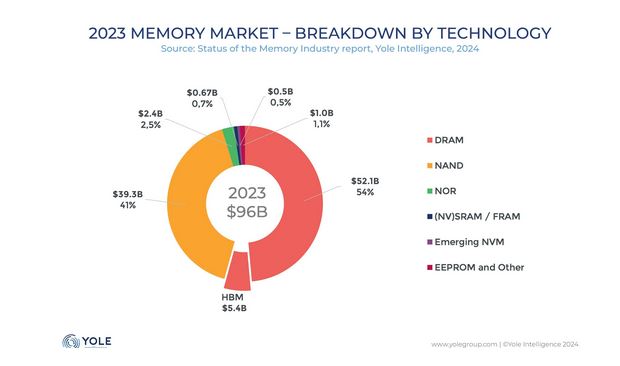
Yole reported that the semiconductor memory market is expected to grow from US$96 billion in 2023 to US$234 billion in 2024, with a 16% CAGR 23-29.
Further finding, analysis and commnets shared by Yole includes:
The burgeoning adoption of generative AI has significantly fueled demand for advanced DDR5 DRAM and HBM technologies within data centers while also triggering increased demand for enterprise SSD s to support AI servers. Additionally, the first smartphones and PCs equipped with on-device generative AI capabilities are entering the market. These devices, requiring substantial memory/storage due to the size of large-language models, are set to further boost bit demand in the mobile and consumer market segments.
Simone Bertolazzi, Ph.D., Principal Analyst, Memory at Yole Group said “In response to this new wave of AI-driven growth, major players such as Samsung, SK hynix, and Micron have shifted a greater portion of their wafer capacity toward meeting the soaring demand for HBM. This shift has led to a deceleration in overall bit production and a hastened transition toward an undersupply of non-HBM products. Production cuts made in late 2022 became effective only in Q3-2023, as OEM inventory levels began to tighten, heralding a rebound in the memory market.”
The memory sector is now on a path to a swifter recovery than previously anticipated, with revenue projections showing a sharp increase for the upcoming years. In 2024, revenues are expected to surge to US$98 billion for DRAM (an 88% YoY increase) and US$68 billion for NAND (a 74% increase). These figures are projected to continue their upward trajectory, reaching new peak levels in 2025 at US$137 billion for DRAM and US$83 billion for NAND. Propelled by robust demand, particularly from data centers, long-term revenue forecasts up to 2029 predict further growth, potentially reaching US$134 billion for DRAM and US$93 billion for NAND, with CAGR23-29 estimated at 17% and 16%, respectively.
Simone Bertolazzi further said “The escalating need for advanced computing chips designed for AI training and inference has intensified competition among top DRAM manufacturers such as Samsung, SK hynix, and Micron. These companies are actively expanding their capacities for cutting-edge HBM3/3E technologies and are swiftly advancing the development and validation of next-generation HBM3E and HBM4 products.”
HBM technology has become crucial for AI systems and is a strategic asset in the geopolitical landscape of AI technology. Due to U.S. export restrictions, China is compelled to independently develop and manufacture its HBM technology to satisfy its substantial demand for high-performance AI memory.
These U.S. restrictions have prompted significant investments and various initiatives within China to manufacture these crucial chips. It is reported that China’s first HBM2 products are maturing and are currently being evaluated by select customers and used internally for the development of server processing units. Despite trailing global memory technology leaders by over six years, Chinese firms are determined to maintain their involvement in essential AI technologies and aim to leverage the extensive local market for lower to mid-range AI accelerators. Moreover, the number of suppliers producing DRAM modules and SSDs incorporating China-manufactured DRAM and NAND is increasing rapidly, underscoring the urgent need for locally produced semiconductor memory devices.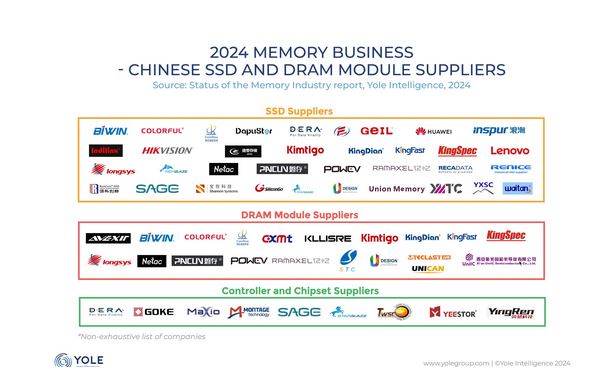
Source: Yole
Tweet Follow @ecewire